gra·no·la [grə-ˈnō-lə]
Granola: The History, The Fables and The Facts
Granola is a breakfast and snack food consisting of rolled oats, nuts, honey, and occasionally rice. Usually baked until crispy, the mixture is stirred during baking to maintain a loose, breakfast cereal-type consistency. Dried fruits, such as raisins bananas and dates, are sometimes added.
Because of all that natural goodness, plus a pleasant sweetish taste, it is the rage right now with a generation that is rebelling against the likes of Sugar Smacks and other products that it considers overpackaged and undernourishing.
In addition to being a healthy food for breakfast and snacks, granola is also often a staple for hikers, campers, or backpacking enthusiats because it is lightweight, high in energy, and easy to store.
Crunchy Granola is often eaten in combination with yogurt, honey, strawberries, bananas, milk, and other cereals. Granola is also a tasty natural topping for pastries and desserts. Recipes that include flax seeds are often used to improve digestion.
Similar to trail mix and muesli, Granola is often fashioned into snack-sized bars.
The names Granula and Granola were trademarked terms in the late nineteenth century United States for foods consisting of whole grain products crumbled and then baked until crispy; in contrast with the contemporary invention, muesli, which is traditionally not baked or sweetened.
The name is now trademarked only in Australia by the Australian Health & Nutrition Association Ltd.‘s Sanitarium Health Food Company where it denotes a product that does not resemble muesli in any way. A hard multigrain flat biscuit is produced and then ground/broken into small pieces a few millimetres in size. This product is then packaged and sold. It is used steamed or boiled as a breakfast cereal.
Granula was invented in Dansville, New York, by Dr. James Caleb Jackson at the Jackson Sanitarium in 1894. The Jackson Sanitarium was a prominent health spa that operated into the early twentieth century on the hillside overlooking Dansville. It was also known as Our Home on the Hillside; thus the company formed to sell Jackson’s cereal was known as Our Home Granula Company. Granula was composed of Graham flour and was similar to an oversized form of Grape-Nuts.
A similar cereal was developed by John Harvey Kellogg. It too was initially known as Granula, but the name was changed to Granola to avoid legal problems with Jackson.
The food and name were revived in the 1960s, and fruits and nuts were added to it to make it a health food popular with the new-age and hippie movements. Several people claim to have revived or re-invented granola. A major promoter was Layton Gentry, profiled in Time as “Johnny Granola-Seed.”
In 1964, Gentry sold the rights to a granola recipe using oats, which he claimed to have invented himself, to Sovex Natural Foods for $3,000. The company was founded in 1953 in Holly, Michigan by the Hurlinger family with the main purpose of producing a concentrated paste of brewers yeast and soy sauce known as “Sovex.”
Earlier in 1964, it had been bought by John Goodbrad and moved to Collegedale, Tennessee. In 1967, Gentry bought back the rights for west of the Rockies for $1,500 and then sold the west coast rights to Wayne Schlotthauer of Lassen Foods in Chico, California for $18,000. Lassen was founded from a health food bakery run by Schlotthauer’s father-in-law. The Hurlingers, Goodbrads, and Schlotthauers were all Adventists, and it is possible that Gentry was a lapsed Adventist who was familiar with the earlier granola.
In 1972, Jim Matson, an executive at Pet Milk (later Pet Incorporated) of Saint Louis, Missouri, introduced Heartland Natural Cereal, the first major commercial granola. At almost the same time, Quaker introduced Quaker 100% Natural Granola. Within a year, Kellogg’s had introduced its “Country Morning” granola cereal and General Mills had introduced its “Nature Valley.”
In 1974, McKee Baking (later McKee Foods), makers of Little Debbie snack cakes, purchased Sovex. In 1998, the company also acquired the Heartland brand and moved its manufacturing to Collegedale. In 2004, Sovex’s name was changed to “Blue Planet Foods.”
Layton Gentry returned to California to operate a small store selling only three varieties of Crunchy Granola. He hopes that the granola business stays spread out, the way he planted it. “I really think if the big companies got their hands on it that it may become a bad word,” he says. “Even now, there’s a lot being made that doesn’t do justice to granola. I felt to do things right there should be small plants in several different places manufacturing it.”
Granola Bars
Granola bars were invented by Stanley Mason and have become popular as a snack. Granola bars are usually identical to the normal form of granola in composition, but instead of a loose, breakfast cereal consistency, granola bars are pressed and baked into a bar shape, resulting in a more convenient snack. The first Granola Bar sold in the United States was patented and manufactured by Edward Thayer Sr. in Chico CA.
The product is most popular in the United States and Canada, parts of southern Europe, Brazil, South Africa and Japan. Recently, Granola has begun to expand its market into India and other southeast Asian countries.
A variety of the granola bar is the “chewy granola bar.” In this form, the time during which the oats are baked is either shortened or cut out altogether; this gives the bar a texture that is chewier than that of a traditional granola bar.
A similar bar exists in Germany and the United Kingdom, known as a flapjack or muesli bar, and other varieties on names with similar ingredients, such as cereal bars, oat bars, and snack bars, exist.
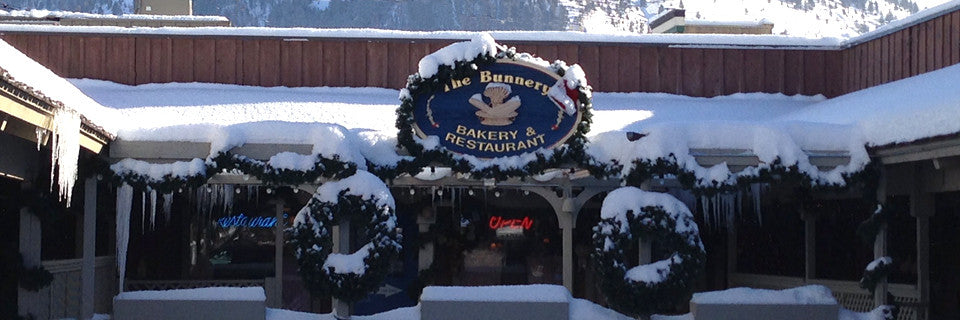
Bunnery Natural Foods, Jackson WY, offers Granola Bars made with rich, Milk Chocolate, and a more heaty Dark Chocolate.
Bunnery Natural Foods for Healthy Lifestyles
Four decades ago, in a log cabin near Yellowstone, The Bunnery started baking natural foods to sustain the outdoorsman drawn to the thrills and challenges of life in the West.
Our home of Jackson, Wyoming, a paradise for skiers, bikers, hikers and fly fishers, is a place that demands you be at your physical best.
Whether you are climbing a mountain, battling white water on the Snake River, or just braving an avalanche of e-mail, our delicious granola, rich in fiber, iron and antioxidants, gives you the strength and satisfaction you need to power through the challenges of your day.
Our team hopes you enjoy the Best from the West — locally produced natural foods from Jackson Hole.
TITLE: Buffalo Fork Crossing”
LOCATION: Grand Teton National Park, Wyoming.
ABOUT PHOTOGRAPH:
Lengthening days in the Tetons promise that spring is on the way. Another symbol of the season of rebirth is the presence of elk with their new calves. Close on the hooves of their mothers, three one-month old calves brave the Buffalo Fork River, a tributary of the great Snake. Once across, the family groups will find safety and an abundance of new grasses to graze on before they continue their migration into the high country of the Gros Ventre Mountains, an equally impressive range that lie opposite of the Tetons.
Limited edition photograph with an edition of 1500.
Matted and framed in a 14×20 with non-glare glass The retail value is $665.00.
For information go to Thomas Mangelsen Gallery
We are so thrilled to be launching our new website! Thanks to all our local, creative Jackson friends… we are up and runnning in cyber world.